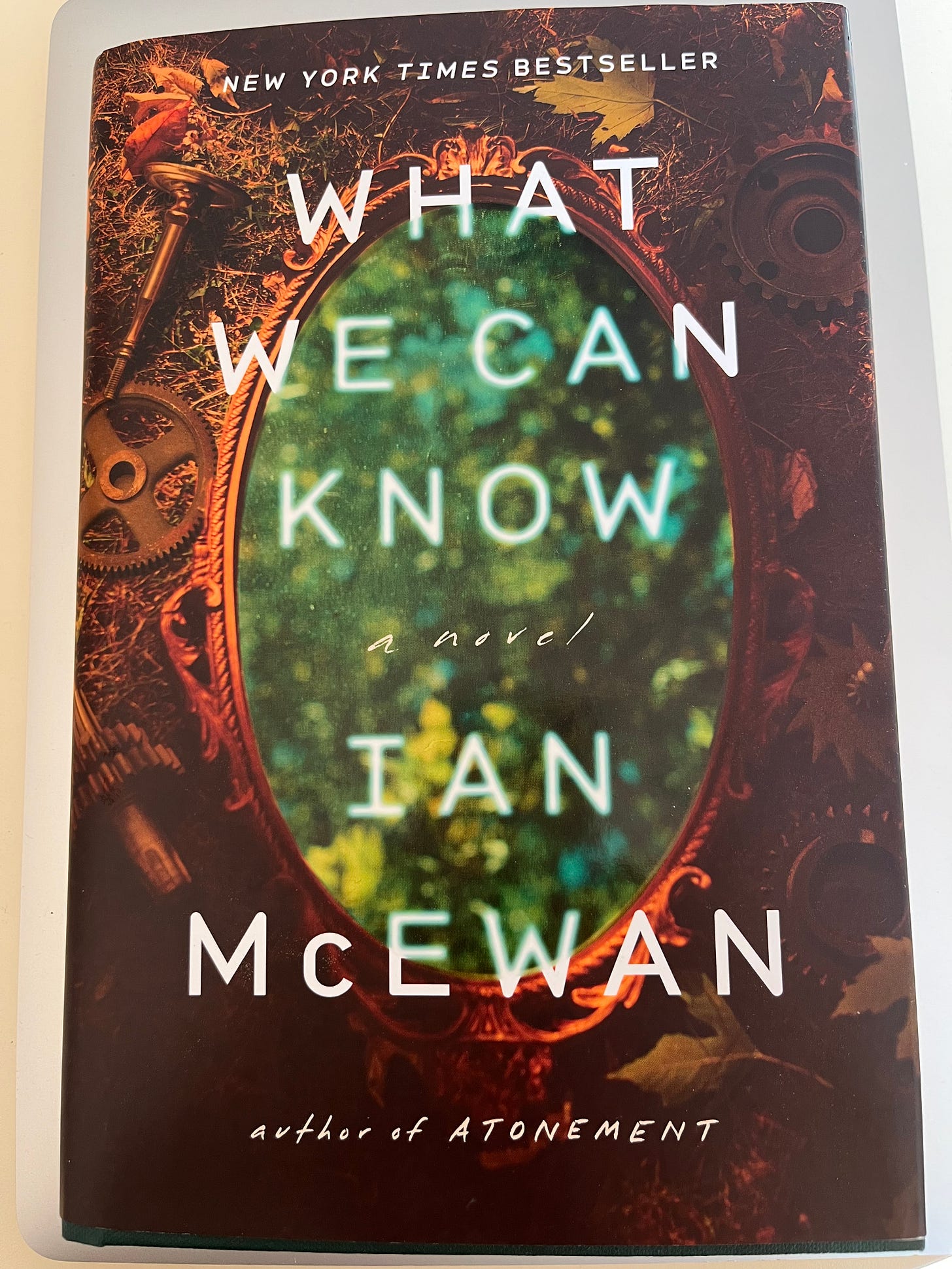
Nobody asked for my review but as a disappointed fan of the author, I have to express my sentiment: I am reading Ian McEwan’s latest book “What we can know” because I read and liked several of his previous books for their sensibilities for the time we live in, his precise and artful language and his detailed introspection.
But this story, set 100 years from now in a dystopian future, lacks a stable narrative arc strong enough to jump back and forth across a hundred years and keep the reader engaged.The author’s as well as the narrator’s literary research interest, already feeling old fashioned in the contemporary setting, appears outright tedious in the apocalyptic future in which it is supposed to take place. Most gravely though, McEwan lacks the imagination to paint out a future so many decades ahead, dystopian or otherwise.
He stays in the lanes familiar to us. Surely they wouldn’t research via an internet or ask AI similarly to we do now, wouldn’t speak, react and aspire in the same words or sentiments as we do. He allows that the various catastrophic events between now and then have slowed technological progress, but that’s no excuse for not imagining any real change for how people live, love, or get around except the the electric boats mentioned several times.
There probably wouldn’t be libraries with actual physical antique books, at least not for the public to go to. His descriptions of the various catastrophic events that had occurred remain bloodless and contrived, except for an Iran war that jumped from his imagination to relaity right after the book was published.
I have the strong impression that the author himself felt his inability to fill this distant future with juice and color, and so he keeps getting back to the here and now, presumably reconstructed from archival material.
But as much as it is supposedly reconstructed from research and much effort, this 100 ago time comes across with the fullness of the contemporary observer which the author of course is.
His future is what remains the abstract and lifeless construct distilled from research, quite backwards from the story’s premise and suffering from not enough research.
“What we can know” is not much, at least when we talk about a future 100 years from now, except that the title refers to the ability to know everything about us, thanks to our obsession to record everything.
McEwan doesn’t allow for the possibility that our everyday digital recordings are too ephemeral and too subjected to specific technology and software to endure for research over a 100 years.
Isn’t it much more likely that future generations not only would care even less about us than we care about the past but that our time actually leaves fewer useable traces?
I have not yet finished the book because my nagging complaints recur chapter by chapter and it is unlikely that this will change during in the final stretch. But I am not one to give up easily, so will pick it up again searching for the raisins of McEwans beautiful language and introspections which remain an attraction even in a weak plot.
Klaus Philipsen, FAIA

Subscribe to:
Post Comments (Atom)

No comments:
Post a Comment